
By Dr. Shedel Williams, PT, DPT
Do your first few steps in the morning feel like you're walking on a bruise? Does your heel hurt after sitting for a prolonged period or spending hours on your feet?
You may be experiencing symptoms associated with plantar fasciitis (pronounced PLAN-ter fash-ee-EYE-tis).
Now, before we go any further, let's practice saying that together because I've heard some very creative pronunciations of this diagnosis throughout my career! Don't worry, by the end of this article, you'll know how to pronounce it AND understand what it means.
As a Doctor of Physical Therapy, I believe understanding why your body hurts is an important part of taking better care of it. Let's explore what's happening beneath your feet.
What is plantar fasciitis?
The plantar fascia is a thick band of connective tissue that runs along the bottom of your foot, connecting your heel to the base of your toes.
It plays an important role in supporting your arch, absorbing forces and helping your foot function during movement.
When the plantar fascia is subjected to more stress than it can tolerate, pain and tissue irritation can develop.
What are the common symptoms?
Heel pain during your first steps in the morning
Pain after prolonged sitting
Discomfort after standing or walking for extended periods
Tenderness along the bottom of the heel
Pain that initially improves with movement but may return with increased activity
Although these symptoms are commonly associated with plantar fasciitis, not all heel pain is caused by this condition.
What does your arch have to do with it?
Your feet are the foundation of your body. Every time you stand, walk or run, your feet are responsible for managing the forces traveling between your body and the ground.
As your arch lowers during weight-bearing activities, tension within the plantar fascia can change. Repeated or excessive loading may contribute to irritation, particularly when combined with other factors such as increased activity, limited ankle mobility or inadequate footwear.
This is where understanding the importance of arch support becomes valuable.
Appropriate arch support may help redistribute pressure and modify the forces experienced by the foot during everyday activities.
Why your footwear matters
Many of us spend hours on our feet without considering what is supporting them.
While cushioning can provide comfort, cushioning and structural support are not the same thing.
A soft insole may feel comfortable beneath your foot, but it may not provide the level of arch support you need.
When selecting footwear or insoles, consider:
The amount of structural arch support
Overall fit and comfort
Stability during movement
Your daily activity level
Your individual foot mechanics
Movement with Dr. Shedel: Plantar Fasciitis
Supporting your feet is only one piece of the puzzle. Improving strength, flexibility and mobility is also important for healthy movement.
As a Doctor of Physical Therapy, I've selected five exercises that target the muscles and structures that support your feet.
Start with the foundational exercises and gradually progress to strengthening as tolerated. Once comfortable in your insoles, you can incorporate them into appropriate standing exercises.
Perform these exercises within comfortable limits and consult a physical therapist if your symptoms persist or worsen.
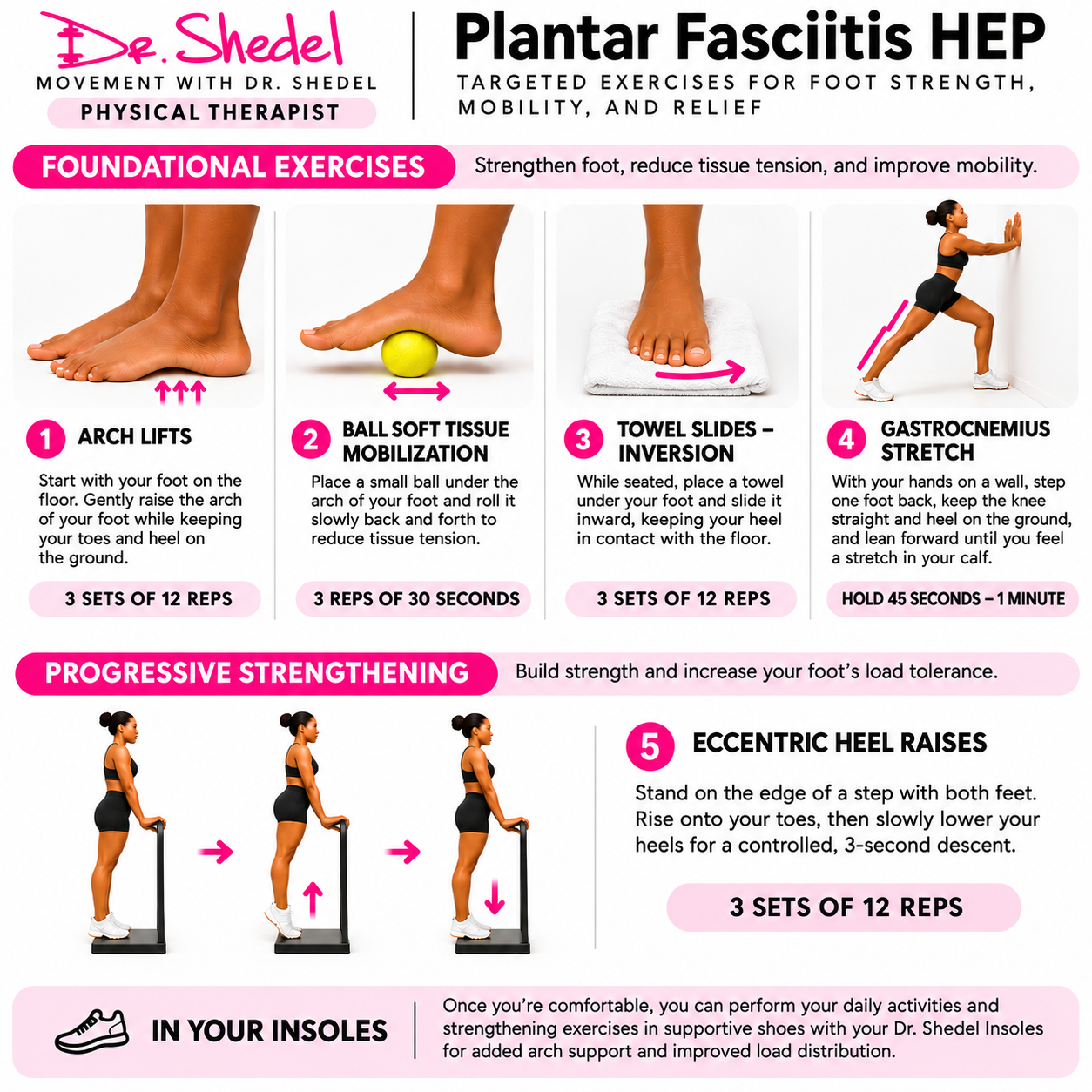
The Dr. Shedel approach
I created Dr. Shedel to make physical therapy–informed products more accessible.
Our insoles combine a structured, 3D-printed base with an EVA foam top layer to provide firm arch support and everyday comfort.
Our philosophy is simple: support should be intentional, not an afterthought.
From daily walks to daily workouts, your feet deserve a supportive foundation.
Take the first step toward better support
Understanding your foot mechanics is an important part of making informed decisions about your footwear and daily movement.
If you are experiencing persistent heel pain, consult a physical therapist or another qualified healthcare professional for an individualized evaluation.
Explore Dr. Shedel Insoles and discover a more intentional approach to supporting your feet.
This article is for educational purposes only and is not intended to diagnose, treat or cure any medical condition.
References
Koc TA Jr, Bise CG, Neville C, Carreira D, Martin RL, McDonough CM. Heel Pain – Plantar Fasciitis: Revision 2023. Journal of Orthopaedic & Sports Physical Therapy. 2023;53(12):CPG1–CPG39.
